Appendix A · Wild Card Poker Odds
How often each hand comes up, with and without wild cards.
These charts compare how often each hand occurs in Five Card Stud, Five Card Draw and Seven Card Stud with no wild cards, two wild cards, four wild cards or eight wild cards.
The four setups
| Wild cards | Cards designated wild |
|---|---|
| None | No wild cards |
| 2 wild | One-eyed jacks |
| 4 wild | Deuces |
| 8 wild | Threes and sixes |
Reading the odds
An entry of 1 in 100 means the hand occurs about once in every 100 deals. A larger number means a rarer hand. A dash means the hand is not possible. The odds tables list hands in the book’s official ranking order.
On the comparison charts, points farther to the right show more common hands. The horizontal gray line shows the range across the four setups. The logarithmic scale gives equal space to each tenfold change in the odds.
Reading the rarity charts
The rarity charts arrange hands from rarest at the top to most common at the bottom. Follow a hand’s code across the four columns to see how its position changes. Green marks a hand rarer than its official position; gold marks one more common. Gray marks the same position.
Rarity does not change the House Rules hand hierarchy. Five of a kind still ranks above a royal flush.
How hands are counted
Wild cards stand for any card, so five of a kind is possible. With wild cards, a royal flush is any ace-high straight flush. Each hand counts as its best possible rank.
Five Card Stud and Seven Card Stud use exact counts. Five Card Draw uses simulations and the draw strategy stated on its chart page.
Five Card Stud
How wild cards change the odds
Five cards dealt, no draw. Exact count of all 2,598,960 deals.
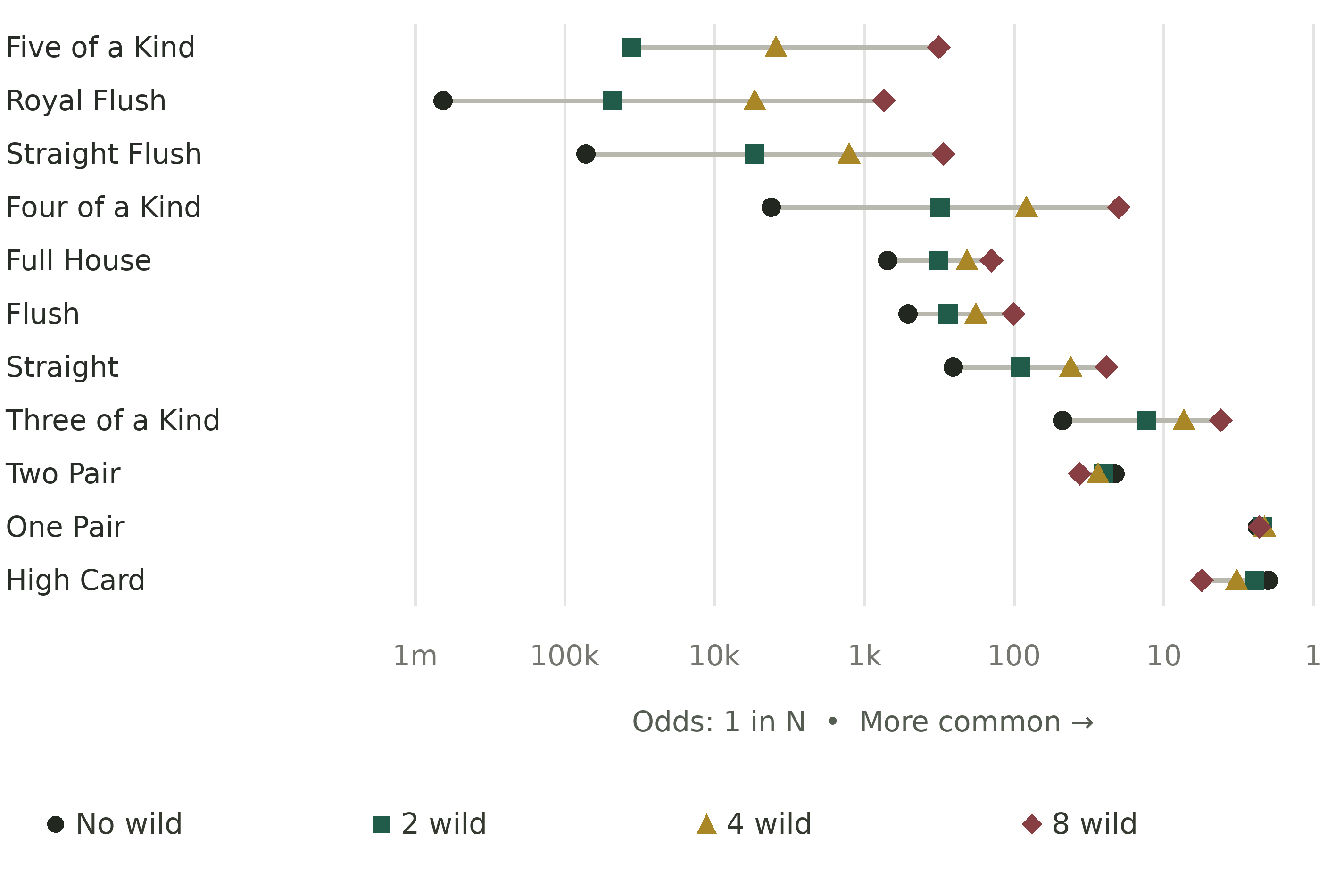
Odds table — each entry means “1 in …”
| Hand | None | 2 wild | 4 wild | 8 wild |
|---|---|---|---|---|
| Five of a Kind | — | 36,097 | 3,868 | 319 |
| Royal Flush | 649,740 | 48,129 | 5,370 | 738 |
| Straight Flush | 72,193 | 5,414 | 1,257 | 296 |
| Four of a Kind | 4,165 | 312 | 82.4 | 19.9 |
| Full House | 694 | 320 | 205 | 141 |
| Flush | 509 | 274 | 180 | 100 |
| Straight | 255 | 89.8 | 41.8 | 24.0 |
| Three of a Kind | 47.3 | 13.0 | 7.3 | 4.2 |
| Two Pair | 21.0 | 25.2 | 27.3 | 36.5 |
| One Pair | 2.4 | 2.2 | 2.1 | 2.3 |
| High Card | 2.0 | 2.5 | 3.2 | 5.6 |
A dash means the hand is not possible. See Appendix A for setups and counting rules.
Five Card Stud
How wild cards change rarity
Five cards dealt, no draw. Exact count of all 2,598,960 deals.
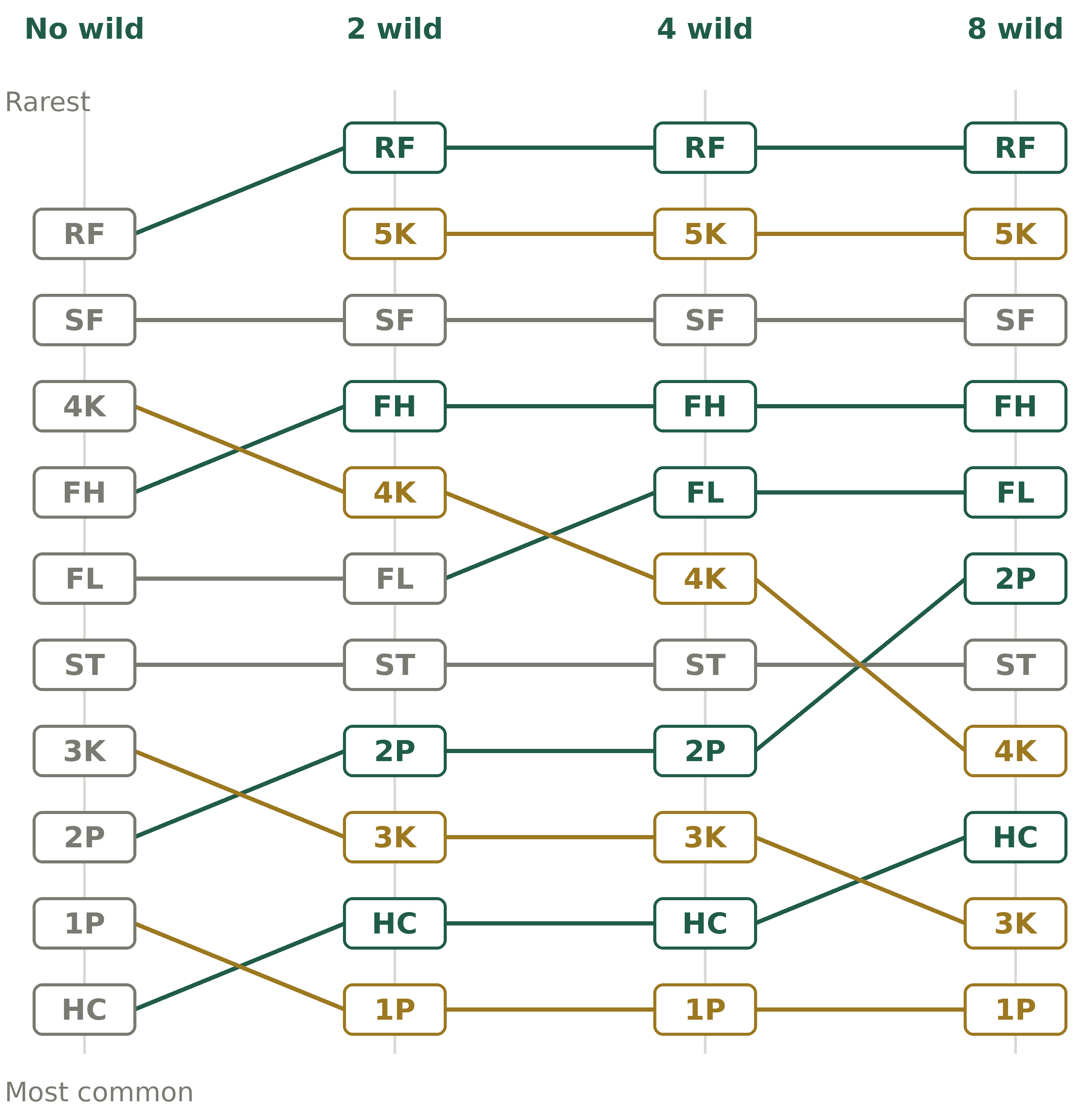
Green = rarer • Gold = more common • Gray = same position
Compared with the official hand ranking; exact odds are on the preceding page.
5K Five of a Kind RF Royal Flush SF Straight Flush
4K Four of a Kind FH Full House FL Flush
ST Straight 3K Three of a Kind 2P Two Pair
1P One Pair HC High Card
With no wild cards, the order by rarity matches the official hand ranking.
Wild cards stand for any card. Each hand counts as its best possible rank. See Appendix A for the counting rules.
Five Card Draw
How wild cards change the odds
Five cards dealt, one draw: up to 3 cards, or 4 when retaining and exposing an ace. Estimated from 20 million deals per setup.
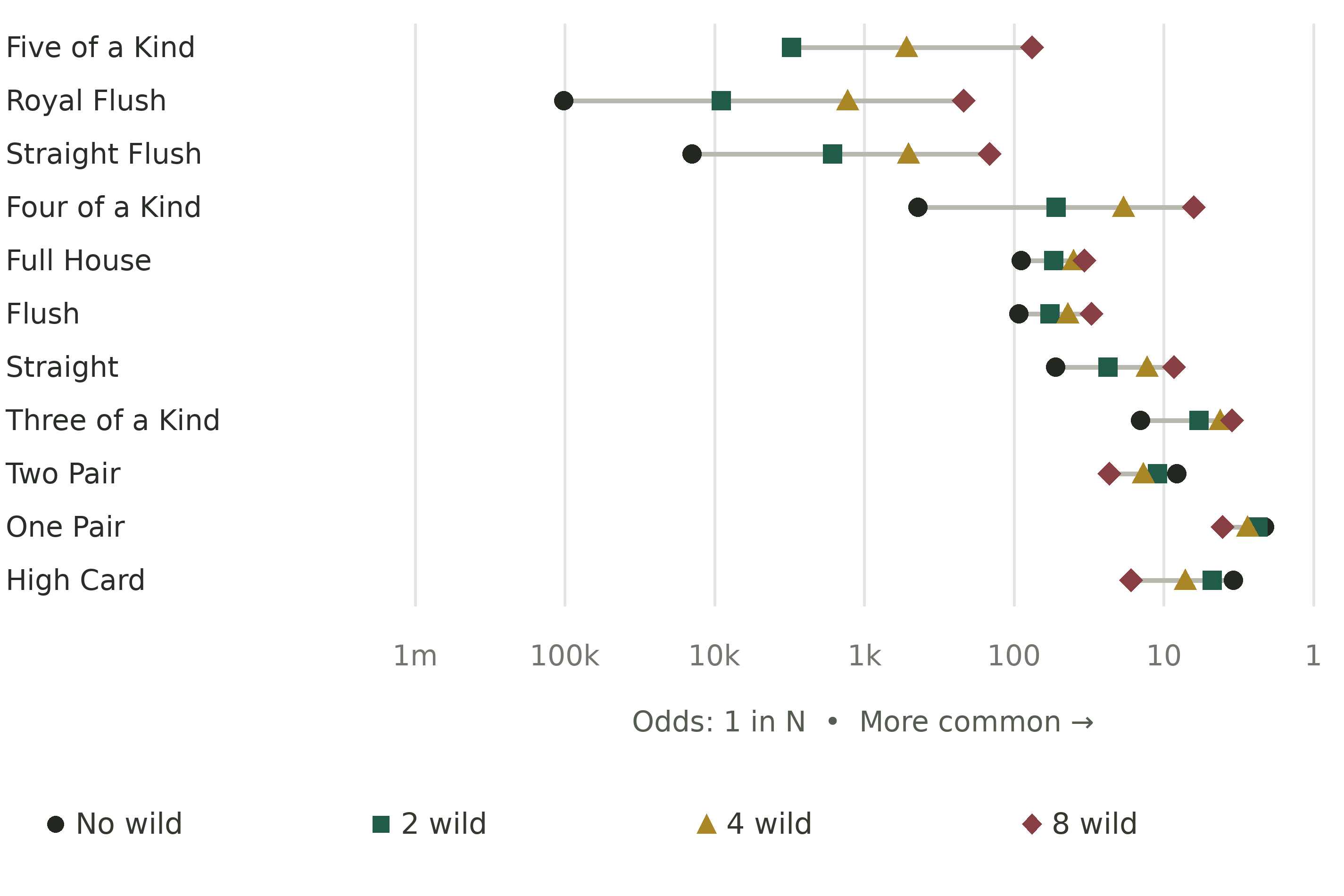
Odds table — each entry means “1 in …”
| Hand | None | 2 wild | 4 wild | 8 wild |
|---|---|---|---|---|
| Five of a Kind | — | 3,060 | 522 | 75.9 |
| Royal Flush | 102,000 | 8,990 | 1,290 | 216 |
| Straight Flush | 14,100 | 1,620 | 507 | 145 |
| Four of a Kind | 439 | 52.4 | 18.6 | 6.30 |
| Full House | 89.5 | 54.1 | 39.9 | 33.8 |
| Flush | 92.3 | 57.4 | 43.4 | 30.3 |
| Straight | 52.5 | 23.6 | 12.9 | 8.50 |
| Three of a Kind | 14.2 | 5.82 | 4.18 | 3.50 |
| Two Pair | 8.18 | 11.0 | 13.6 | 23.1 |
| One Pair | 2.12 | 2.34 | 2.75 | 4.05 |
| High Card | 3.43 | 4.73 | 7.17 | 16.5 |
A dash means the hand is not possible. See Appendix A for setups and counting rules.
Five Card Draw
How wild cards change rarity
Five cards dealt, one draw: up to 3 cards, or 4 when retaining and exposing an ace. Estimated from 20 million deals per setup.
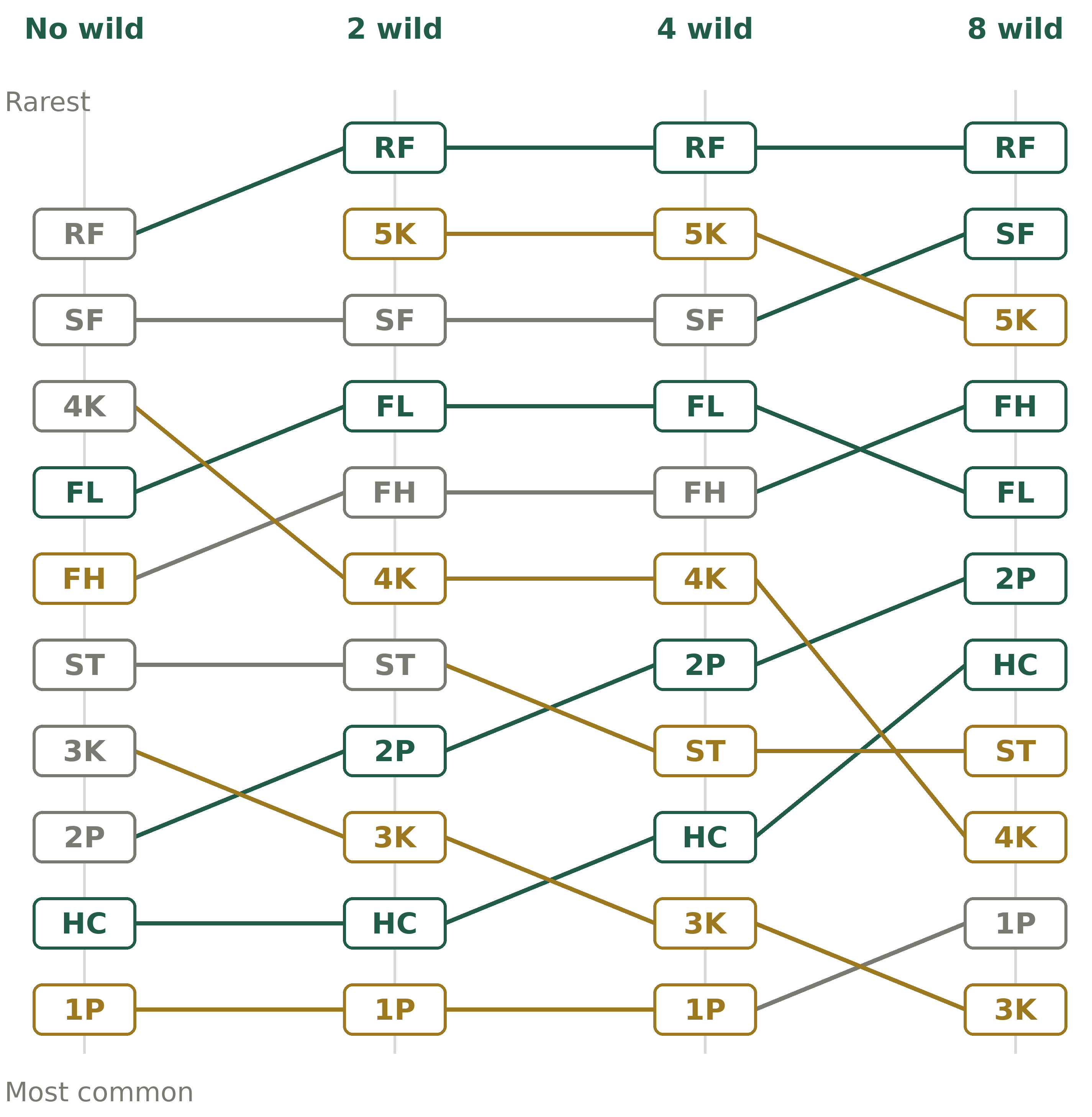
Green = rarer • Gold = more common • Gray = same position
Compared with the official hand ranking; estimates are on the preceding page.
5K Five of a Kind RF Royal Flush SF Straight Flush
4K Four of a Kind FH Full House FL Flush
ST Straight 3K Three of a Kind 2P Two Pair
1P One Pair HC High Card
With no wild cards and the stated draw strategy, high card is rarer than one pair but more common than two pair. Simulated odds are rounded estimates.
Draw strategy: Keep all wild cards. Stand pat with a straight or better. Otherwise prefer trips, two pair, four to a flush, four to a straight (including an inside draw), then a pair. With none of these, keep an ace and draw four; without an ace, keep the two highest cards and draw three. When several straight draws qualify, use the highest. Replacements come from the 47 undealt cards; opponents are not modeled. These are simulated estimates, not exact odds.
Seven Card Stud
How wild cards change the odds
Best five of seven cards. Exact count of all 133,784,560 deals.
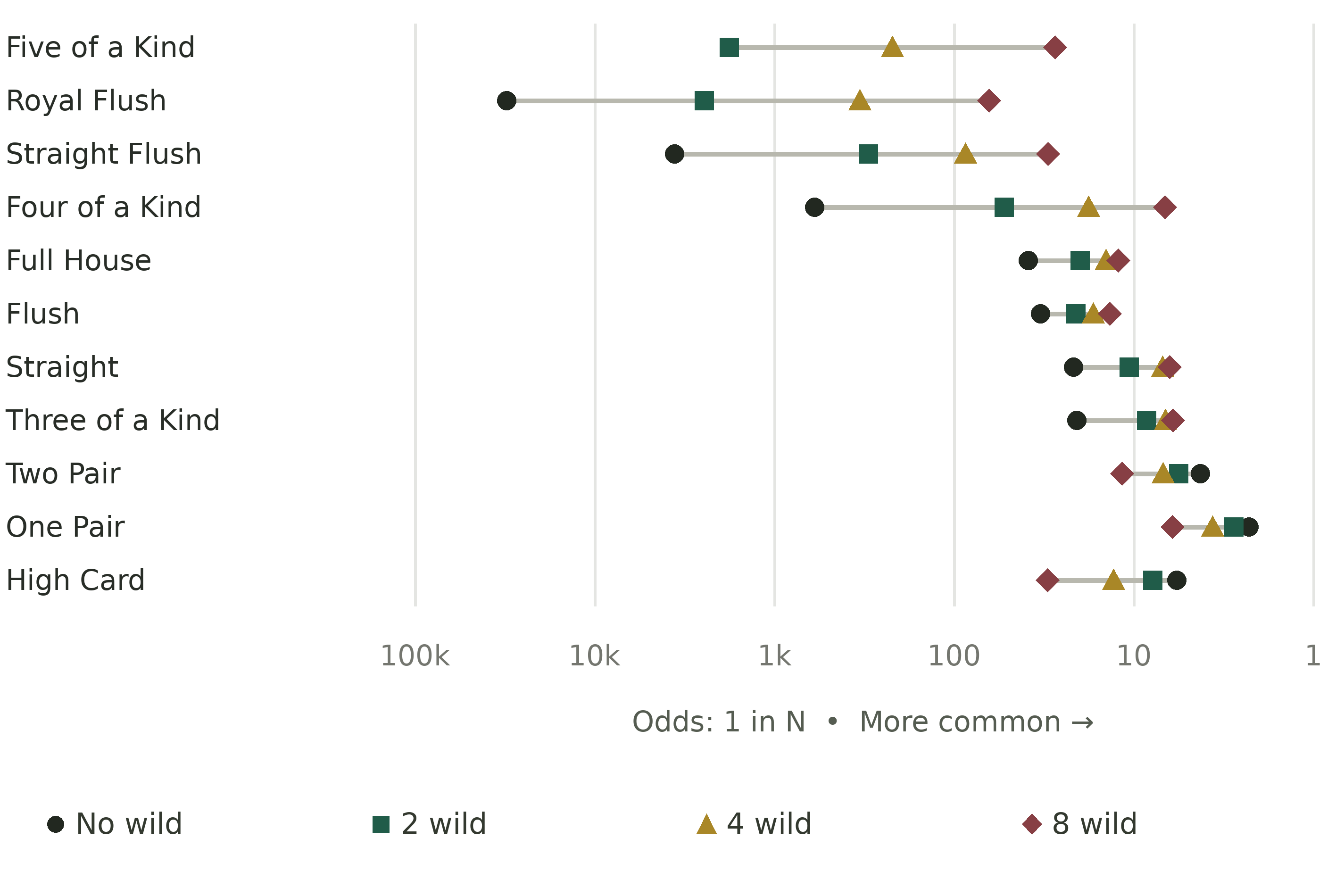
Odds table — each entry means “1 in …”
| Hand | None | 2 wild | 4 wild | 8 wild |
|---|---|---|---|---|
| Five of a Kind | — | 1,782 | 219 | 27.3 |
| Royal Flush | 30,940 | 2,454 | 335 | 63.6 |
| Straight Flush | 3,591 | 299 | 86.2 | 29.9 |
| Four of a Kind | 595 | 52.4 | 17.8 | 6.7 |
| Full House | 38.5 | 19.9 | 14.2 | 12.2 |
| Flush | 33.1 | 20.9 | 16.7 | 13.5 |
| Straight | 21.6 | 10.6 | 6.9 | 6.3 |
| Three of a Kind | 20.7 | 8.5 | 6.6 | 6.0 |
| Two Pair | 4.3 | 5.6 | 6.9 | 11.6 |
| One Pair | 2.3 | 2.8 | 3.6 | 6.1 |
| High Card | 5.7 | 7.8 | 12.9 | 30.2 |
A dash means the hand is not possible. See Appendix A for setups and counting rules.
Seven Card Stud
How wild cards change rarity
Best five of seven cards. Exact count of all 133,784,560 deals.
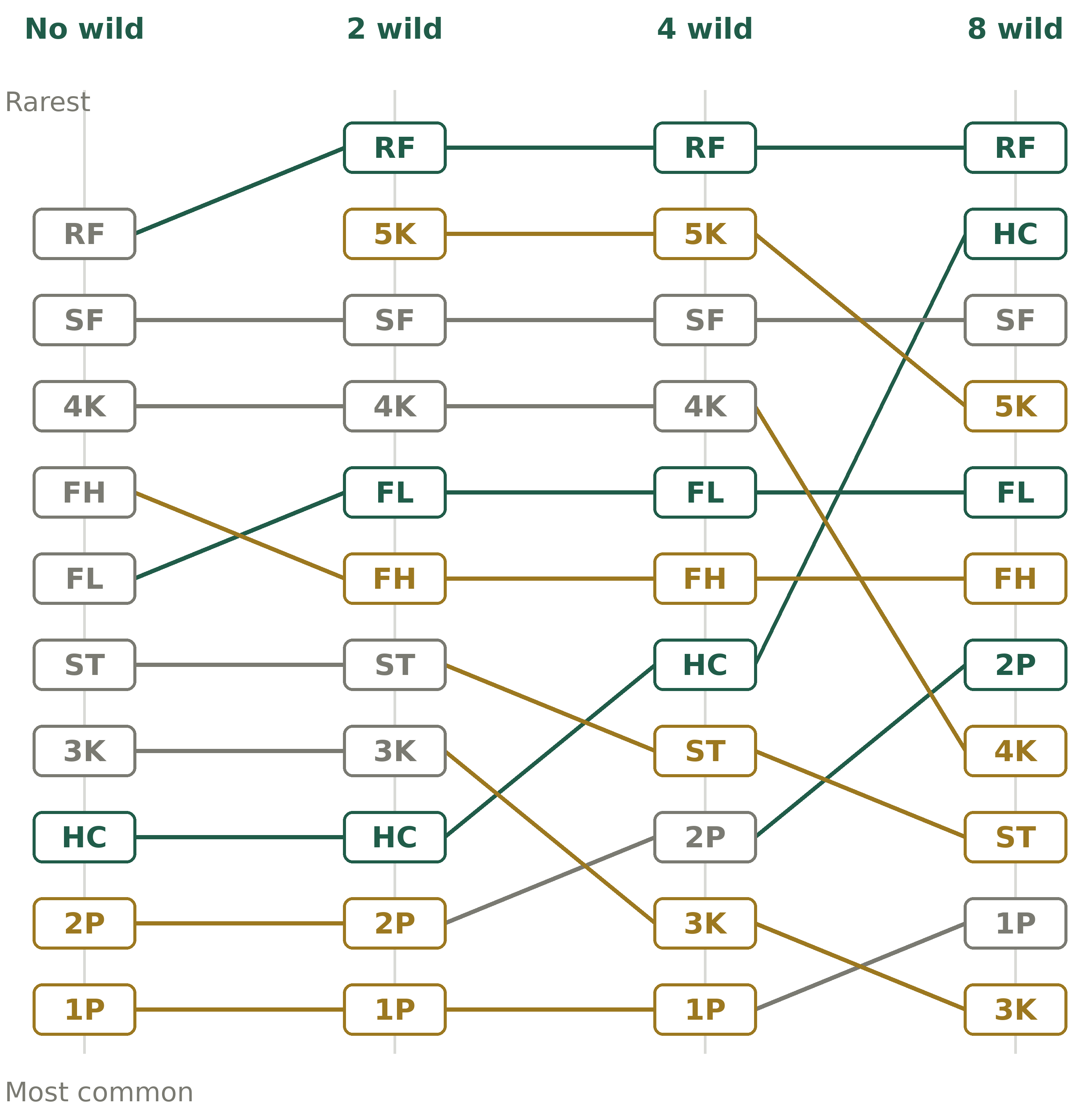
Green = rarer • Gold = more common • Gray = same position
Compared with the official hand ranking; exact odds are on the preceding page.
5K Five of a Kind RF Royal Flush SF Straight Flush
4K Four of a Kind FH Full House FL Flush
ST Straight 3K Three of a Kind 2P Two Pair
1P One Pair HC High Card
Even with no wild cards, high card is rarer than one pair or two pair because you get to pick the best five of seven.
Wild cards stand for any card. Each hand counts as its best possible rank. See Appendix A for the counting rules.